






For B2B companies selling to local businesses with $20,000+ LTV

Get 15-30+ Qualified Sales CallsEvery Single Month.

Booked With Owners and MDs of Local Businesses, at a 70%+ Show Rate and a 30% Close Rate.

Watch how it works6 min

Trusted by Partners

heyreachthanksioinboxkitsendkitmasterinboxlocalpipeaiarkzaidwoodheyreachthanksioinboxkitsendkitmasterinboxlocalpipeaiarkzaidwood

We've sent 20M+ cold emails over the last 5 years. We know what works.

Proof

Meetings Booked With Decision-Makers At

Morgan Stanley
Deloitte
Google
Microsoft
IBM
Apple
Disney
Walmart
Facebook
Airbnb
Spotify
Snowflake
RBC
Miro
Gymshark
0

Meetings Booked With Local Businesses, and Counting.

We know what works at every level. And we can make it work for you.

Fill My Calendar
0
Cold emails sent
0
Leads generated
0
Revenue generated
0
Clients served

Results

Results We've Gotten.

Different industries. Different timelines. Same system.

$1.2M
Cash collected in 7 months

Timote, founder of YWS. One campaign, run for 90 days.

Service business
$700K
Raised in 3 months

Justin, outbound capital raise for a film.

Media
200+
Leads in 3 weeks

Came to us already running his own cold email at about 30 leads a week. We audited it and fixed the constraint.

B2B services
$15K
Closed in the first 2 weeks

Website design agency, from a standing start.

Agency
10 leads a day. 80 booked calls in 90 days.

This one took until month three. Nothing worked, we kept testing, then we cracked it. We're showing you this one on purpose.

Home services

Customers

Hear It From Them.

"$1.2M cash collected in 7 months."
Timote, Founder, YWS
"$700K raised in 3 months."
Justin

The Gap

Why Every Other Channel Fails to Reach Local Business Owners.

Not because you ran them badly. Because of how they're built. Here's the honest breakdown, including where ours would fail.

1. Cost vs. effectiveness

Not cost on its own. What you pay for one real conversation with a buyer. A channel can be cheap and useless, or expensive and still the best deal on the table.

2. Data moat

Is what you're building yours, or are you renting it? If a competitor with the same budget can copy your channel by opening an account, you don't have an advantage. You have a subscription.

3. Scalable and predictable

Can you turn a knob and get more? Can you tell me what you'll get before you spend? You've got a number to hit and a date to hit it by.

We'll Run Every Method Through These Three, Including Ours. If Ours Fails on One, You Should Walk.

DEMAND CAPTURE

They decide when.

Social · Ads · SEO

You put something out and wait for the buyer to raise their hand.

DEMAND CREATION

You decide when.

Cold email · Cold calling · Direct mail · Trade shows

You go and find the buyer and start it yourself.

Out of every contractor, clinic or restaurant in your market that could buy from you, how many are actively looking this week? A sliver. Demand capture only ever reaches that sliver, and that's the ceiling of the entire channel. Capture channels also don't answer to your calendar. You can't decide Q3 needs to be 40% bigger and make SEO comply. You can decide that with outbound.

01

Social media & content

Nothing builds trust faster, and content leads show up already sold. But your pipeline is a direct function of your output. Post more, get more. Stop for three weeks and it goes quiet three weeks later. Without a team producing at volume, the channel is capped by one person's capacity, and that person is usually you.

Cost Moat Predictable
Fails onPredictable. There's no knob to double it next month.
02

Paid ads

Fast, and they genuinely scale. But local owners aren't scrolling to shop your category. A contractor isn't on Facebook researching B2B vendors, he's running jobs. You're renting attention from someone who isn't in buying mode. And the cost curve runs the wrong way. Creative fatigues so you film constantly, and the platform gets more expensive as more people bid in.

Cost Moat Predictable
Fails onData moat. Your competitor opens an account tomorrow and bids against you.
03

SEO

One of the best long-term plays there is, because it compounds. Rank for the right term and you get free qualified traffic for years. The constraint is time. Months of production before it moves, against sites that have been at it for a decade. Nine to eighteen months is normal.

Cost Moat Predictable
Fails onTiming. A great answer to where your pipeline comes from in 2028. A bad answer to where Q3 comes from.
04

Cold calling

This deserves real respect. Nothing beats a live human conversation and it's the fastest route to a booked meeting that exists. But the constraint is human. One rep, one conversation at a time. Every increment of volume costs a salary plus hiring, training and replacing. Underneath that is a data problem: you need owners' mobiles, not the front desk.

Cost Moat Predictable
Fails onCost to scale.
05

Manual cold email

Right channel, wrong labour model. Email is the one place a local owner is guaranteed to look. He owns his inbox, he checks it, no algorithm decides whether he sees you. But when it’s manual, the time doesn’t go into selling, it goes into finding people. One person by hand touches a few hundred prospects a month. And at real volume off your main domain you land in spam.

Cost Moat Predictable
Fails onVolume. Right instinct, no infrastructure.
06

Trade shows

The closest competitor to what we do, and the one I respect most. A room full of owners actively spending money on their business. They flew there, they paid for a ticket. Two constraints, neither about how well you work the floor. The booth runs $5,000 to $10,000 before travel, so call it $15,000 for a proper presence. And the calendar is finite. Four shows at $15,000 is $60,000 for four bursts of pipeline, on dates the industry picked for you.

Cost Moat Predictable
Fails onPredictable. Your pipeline runs on somebody else's calendar.
01 / 06Keep scrolling

So what did you actually pay for at that trade show?

You'd say the booth and the conversations. Fair enough. But the real value in that hall isn't the twelve badge scans you got over three days. It's that somebody else assembled and validated a list of businesses that spend money to grow, and published it in advance.

Most companies work their twelve scans and let the other nine hundred names sit there.

The Room Is the Value. The Room Is a Data Set.

That list is one you can work 365 days a year, for less than the booth cost. Same buyers. Same intent signal. No travel. Nobody dictating your dates.

Trade shows are just the easiest one to picture. We do the same thing with licensing and permit records, industry associations, local directories and review platforms. Anywhere your buyers register themselves as a real, active business.

Our Methodology

The Local Legend Method.

Four channels, one list, in a specific order. Cold email, then cold calling, then cold LinkedIn and handwritten direct mail.

1. Prove the message on cold email

The cheapest and fastest way to find out what your market actually responds to. Nothing gets layered on until we know which message works. There's no sense putting money into a handwritten letter carrying copy we're not sure about.

2. Layer calling on the proven message

Same angle that's already getting replies. Now the phone amplifies something we know lands.

3. Add LinkedIn and handwritten mail

For the accounts worth real money. By that point we're putting proven copy in front of them rather than a guess.

Your Spend Only Goes Up After We Know What Works.

Dave Whitfield
Whitfield Plumbing & Heating
Cold
TOUCH 01
A handwritten letter arrives

Physical mail, real signature, sitting in a stack of nothing but bills. He opens it. He remembers it.

TOUCH 02
Your email lands a few days later

He's already seen your name. It isn't cold anymore.

TOUCH 03
The LinkedIn request

Confirms you're a real person at a real company, not a bot.

TOUCH 04
Then the call happens

That isn't a cold call. That's a call to someone who has seen your name four times and knows what you do.

Same list. Four touches. Each one lifts the next.

That's why this compounds instead of just adding up. Email gives you volume calling can't. Calling gives you immediacy email can't. Direct mail gets past the inbox entirely for accounts worth real money. And LinkedIn makes you a person instead of a domain name.

The Moat Is the Data. Not the Tools.

Same tool, same export, same list as everyone else. Here's what that actually looks like landing in an owner's inbox.

Bought off a tool
CompanyWhitfield Plumbing
Contactinfo@whitfieldplumbing.com
Ownernot in the database
Mobilenot in the database
Signalnone
"Hi there, I help plumbing companies get more leads. Open to a quick chat?"
Deleted. Fourth one this week.
Built by us
CompanyWhitfield Plumbing & Heating
Contactdave@whitfieldph.com
OwnerDave Whitfield
Mobileverified
SourceCounty permit register
Pulled a commercial permit, 6 days ago
"Dave, saw you pulled the permit on the Grafton Street job. Most shops your size start losing track of quoting around the second crew. Worth a look?"
Replied.
Proprietary sources
Verified owner contact
Buying signals
1-to-1 personalisation

To copy that, a competitor has to rebuild the data infrastructure and then run it long enough to learn what we already know. That's the moat.

What Actually Happens

From Signing to Your First Meeting.

Two to three weeks. No mystery, no black box. This is the whole thing, in the order it happens.

01
Week 1
Strategy

We do the math before you sign anything.

Tell us the number you want to hit and the date you want to hit it by. We work backwards from it. How many closed deals that is, how many calls that takes at your close rate, how many replies that takes, how many contacts that takes. By the end of it we both know exactly what these campaigns have to do to be worth your money.

Then we pick the offer angles we'll test first and agree what a win looks like for each one.

You see the whole thing before you pay us a dollar. And if the math doesn't come out in your favour, I'll be the one to say so.

02
Week 1
Data

We go and build a list nobody else has.

Nobody sells a database with every business in your market in it. So we build one. Licensing and permit records, industry associations, local directories, review platforms, trade show exhibitor lists, company registrars. Anywhere your buyers have registered themselves as a real, active business that spends money.

Then we go and find the owner. His actual name, his direct email, his mobile, plus the signals that tell us he's worth contacting this month rather than next year. Hiring. Opened a second location. Just pulled a permit. New licence.

The businesses that don't turn up in any single database are usually the ones nobody else is emailing. Those are the ones you want.

03
Weeks 1 to 2
Deliverability

Getting into the inbox is a different job when your buyer uses Gmail.

Most local owners run their business off Gmail, Yahoo or Outlook. Landing in those inboxes is a completely different problem to hitting a corporate domain, and most cold email setups were never built for it. Ours was.

We put you on separate sending domains, so you can send thousands a day and never touch the reputation of the domain your invoices go out from. They need about two weeks to warm up and nothing goes out while they do.

That wait isn't us being slow. It's the difference between the inbox and the spam folder for the next year.

How your sending is separated
yourcompany.com
Never sends a single cold email. Your invoices and client replies keep landing.
go-yourcompany.comHealthy
yourcompany-mail.comHealthy
try-yourcompany.comHealthy
get-yourcompany.comReplaced
GmailOutlookYahooPrimary inbox
Underperforming mailboxes are swapped out automatically
04
Day 15 to month 1
Testing

Month one is finding the message. Everything after that is volume.

Every company arrives with a different set of unknowns. Some have a great offer and no idea whether the market wants it cold. Some know exactly who to talk to and have never found the words. We're straight with you about which one you are, then we test in blocks, with enough volume in each block to actually tell us something instead of leaving us guessing.

Day 15, the first emails go out. What gets replies gets more volume. What doesn’t tells us what to try next. We keep going until we hit message-market fit, the one combination of offer, message and target that books meetings for your team over and over.

05
Ongoing
Appointment setting

Somebody replies in five minutes, then picks up the phone.

We source, train and manage a setter whose only job is to answer replies within five minutes and get that person onto your calendar. Five minutes is the whole trick. An owner who replied between two jobs is gone twenty minutes later.

They also pre-qualify, so what lands on your calendar is a real prospect and not just anyone who hit reply. Positive leads come with a phone number attached so your team can dial straight away. If you haven't got someone to make those calls, we do it.

06
Weeks 1 to 2, then ongoing
Sales process

The part everyone skips, and it's why their leads don't show up.

Cold leads are strangers. They raised their hand in twenty seconds and went straight back to running their business. By the time your call comes round they can barely remember agreeing to it. That’s a process gap, not a lead quality problem.

So we build the whole thing. A page they land on after booking that pre-educates them, a confirmation sequence, and four to five emails before the call that answer the objections in advance. Very similar to the page you'll land on after you book with us, actually.

Teams we install this for average a 70%+ show rate, some north of 85%, at around a 30% close rate.

07
Month 1 onwards
Reporting

You see the cost of everything, all the way through to a closed deal.

Cost per contact, cost per reply, cost per booked call, cost per customer. Show rate and close rate broken out by segment. Live dashboard, not a monthly PDF.

That isn't for show. Those numbers are what tell us where to push next month, which segment to double down on, which angle to kill. And every lead lands in your CRM with whatever fields you want on it.

Attribution runs the whole way
First email sent
Replied
Call booked
Showed up
Closed deal
Cost per contact
Cost per reply
Cost per booked call
Cost per customer
Broken out by segment, angle and channel
08
Month 3+
Forecast & handover

Where this stops being a campaign and becomes a channel.

Once the campaigns are producing meetings consistently, we build you a model on your real numbers. Then I'll tell you exactly what scaling looks like. How many more emails we send, how many more calls that gets you, what it costs, and which bottleneck we have to unblock first.

That's what predictable actually means. Not a promise, a model you can put next to your other channels and compare.

And after twelve months, if you'd rather own this in-house, we'll help you. We find the people, we interview them, and we train them on the exact system we built for you. I'd rather help you own it than lose you for wanting to.

Booked calls, modelled forward
TODAYMONTH 1MONTH 3MONTH 6CALLS
What the channel has doneWhat it does if you scale it
Built on your cost per contact, reply, booked call and customer

Who This Is For

It'll Work for Your Team Too, as Long as Four Things Are True.

A genuinely good product

Something your customers find real value in.

Happy customers and case studies

So we've got glowing proof to point at.

A sales team that closes

We bring qualified prospects. Someone has to convert them.

Willingness to test properly

Most clients crush it out of the gate. But sometimes we don't hit a home run until month two or three. I'd rather tell you that now than sell you a fantasy.

And if I genuinely don't think we can get results for your business, I won't take you on. If I take you on and the results are lacklustre, I've wasted your time and mine.

Price

Straight Answer on Price.

$6,000 to $25,000 a month. Fully customised.

Cost is driven by volume. More contacts a month means more data, more sending infrastructure and more setter time to work the replies. So we price to the number of meetings you actually want, not to a tier chart. On the $6,000 package you can expect a minimum of 15 qualified calls a month.

On the call we build a model with your numbers. Your average deal size, your close rate, the volume we'd run. It shows exactly what ROI this channel generates at each price point, so you see the number before you decide anything. And if the model doesn't work in your favour, I'll be the one to say so.

A trade show booth

$15,000 all in for three days of pipeline, on a date somebody else picked.

An in-house SDR

More than this fully loaded, and a quarter to ramp.

Legacy GTM

Runs 365 days a year with a forecast attached.

Say Less. Fill My Calendar.

15 to 30 qualified calls a month with local business owners who want what you sell. Book a strategy call and we'll build the model with your numbers on the call, whether or not you work with us.

No hard sell. If I don't think we can win for you, you'll hear it from me on the call. Either way you walk away with the strategy. That part's yours regardless.

FAQ

Every Question I Get Asked.

Price, guarantees, timelines, in-house vs. agency, and what to do if you've tried cold email before.

Have you done this before in my niche?
Over five years and 40+ clients we've covered just about every kind of business. $40,000 hot tubs to homebuilders, coaching to financial advisors, marketing services to lawyers, M&A to local business owners, TikTok marketing to ecommerce and SaaS. But the more useful answer: the process is the same for every niche. We find your ICP, build a custom process to pull proprietary data on them, enrich it, find buying signals, write 1-to-1 personalised outreach, and install a sales process built to close outbound leads. The niche changes what we say. It doesn't change how the machine works.
I've done cold email before and it didn't work.
In our experience it’s almost always one of six things. Deliverability, so you were in spam. Your offer, a warm-traffic offer sent cold. Your messaging. Your targeting. Experience. Or, underneath all of it, no diagnostics, so something broke and there was no way to know which of the five it was. If you’ve run cold email at real volume, we’ll audit your account and tell you exactly what’s broken. One client came to us at about 30 leads a week. We found the constraint and he pulled 200 leads in three weeks.
My show rate on cold outbound is terrible.
You're right to raise it. Cold outbound can run under 50% show rate without the right process. There's no relationship yet. They raised their hand in twenty seconds and went back to running their business, and nothing in between reminded them why they said yes. That's a process gap. We build a pre-education funnel, a confirmation sequence and four to five pre-call reminder emails that handle objections in advance. Clients we install this for average a minimum 70% show rate, some north of 85%.
I don't like getting cold emails. Won't my clients feel the same?
I like this question, because it means you care what your market thinks of you. But just because you don't like getting cold emails doesn't mean your buyers feel the same. Say you're behind on your books, tax season is coming, and a local reputable accountant who's worked with businesses like yours asks if you'd like help. Would you reply no? What you hate isn't cold email, it's irrelevant email, the blast that clearly went to ten thousand people. That's what all the data work is for.
How fast can I see results?
Anywhere from one week to two or three months, and I'll be straight about why the range is wide. You're starting a new channel with no proven messaging, and anyone who tells you they know exactly which message will work before sending a single email is guessing at you. On average we get clients solid results inside the first month. The honest spread: one client got nothing until month three, then went to 10 leads a day and 80 booked calls in 90 days. Another's first campaign closed $1.2M in annual contracts. Another pulled 200 leads in three weeks.
How scalable and consistent is this? Real leads or a nice dashboard?
The right question to ask. This system has produced results consistently for five years, and our longest-running client was on it two years plus. Once you've found a message and offer that generate leads, the hard part is done. From there it's contacting new people at enough volume. It's math. We report cost per contact, cost per lead, cost per booked call and cost per acquisition, and you get a forecast model you can hold us to. Replies and booked meetings are the only metrics that mean anything.
How do you hit a 30% close rate?
Two things, neither magic. The leads are pre-qualified before they hit your calendar, so we're not booking anyone with a pulse. And the process warms them up before your rep ever speaks to them. They land on a funnel like this one, get pre-educated, and get four to five reminder emails that handle objections in advance. So they show up at least 70% of the time and they show up already trusting you. Your rep isn't starting from zero.
My last agency burned me. How are you different?
I'm sorry you went through it. An agency is one of the easiest businesses on earth to start, and I've been on the receiving end too. But would you give up on scaling your business because someone burned you? Then they won twice. So here's what to check. Five years, 40+ clients, 20M+ cold emails, $5M+ in revenue generated from this channel, and a process built specifically for local businesses rather than a generic playbook bent to fit. And the structural difference: we don't make money by signing you, we make money by keeping you.
Do you offer a guarantee?
No, and I’ll give you a real answer instead of the one that’s easier to sell. A guarantee is a condition that has to be met by a deadline, and look at what that does to incentives. The client becomes incentivised to void the condition. The agency becomes incentivised to hit the number at all costs, which in practice means spamming your entire market or padding metrics. I’ve watched an attempt to fulfil a guarantee destroy the very thing that was working. The real question isn’t can you hit the guarantee, it’s can you sustain this channel for years.
Do you do pay-per-lead or commission-only?
No, and it works in your favour. Pay-per-lead incentivises us to send as many leads as physically possible regardless of quality, so your reps burn hours on people who technically fit and were never going to buy, and eventually they stop trusting the channel, which is worse than having no channel. And on your side it incentivises declining leads to protect margin. We make far more from you winning and growing than we ever could from squeezing you.
Why hire an agency instead of building this in-house?
Depends on your budget, time and experience. In-house works when you already have a strategy you know produces results, budget to carry a hire for six to twelve months, and patience to let them figure it out. You come to an agency when outbound is new to you. First booked meeting often in one to two weeks, where an in-house hire spends a quarter learning what we already know. Most teams hire the agency first and then hire in-house. We blaze the trail, prove the channel, then help you hire, train and take it over.
Can't I just hire a freelancer?
If you're tight on budget and want a cheap way to test the water, go for it. I'm not going to pretend that's crazy. But most of our clients tried the cheap option first. The reason it usually doesn't work isn't talent, it's that this isn't one skill. It's deliverability infrastructure, proprietary data sourcing, cold-traffic offer design, copywriting, and an outbound-specific sales process. Five disciplines, and the whole thing only produces when all five are handled. A freelancer will be genuinely good at one.
Why is it so expensive?
Expensive compared to what? If we deliver 15 qualified calls a month with local owners who want what you sell, and you close them into customers paying you tens of thousands, would you make that payment every time? If I know I can invest $4,000 and get $50,000 back, I’m making that investment all day. At that point it stops being an expense and becomes a purchase.
Are you going to hard sell me on the call?
No. One, I think it's unethical. Two, it would be terrible for us. If I hard sell you and we don't deliver, in a market this small my reputation gets dragged and we lose far more than we made off you. What actually happens: we talk, I ask about your business, your offer and your numbers, and I work out whether there's a real gap my team can fill. If there isn't, I'll tell you on the call. Either way you walk away with the strategy. That part's yours regardless.

The Receipts

Every One of These Is a Real Dashboard.

Client names blurred, numbers untouched. Click any of them to see it full size.

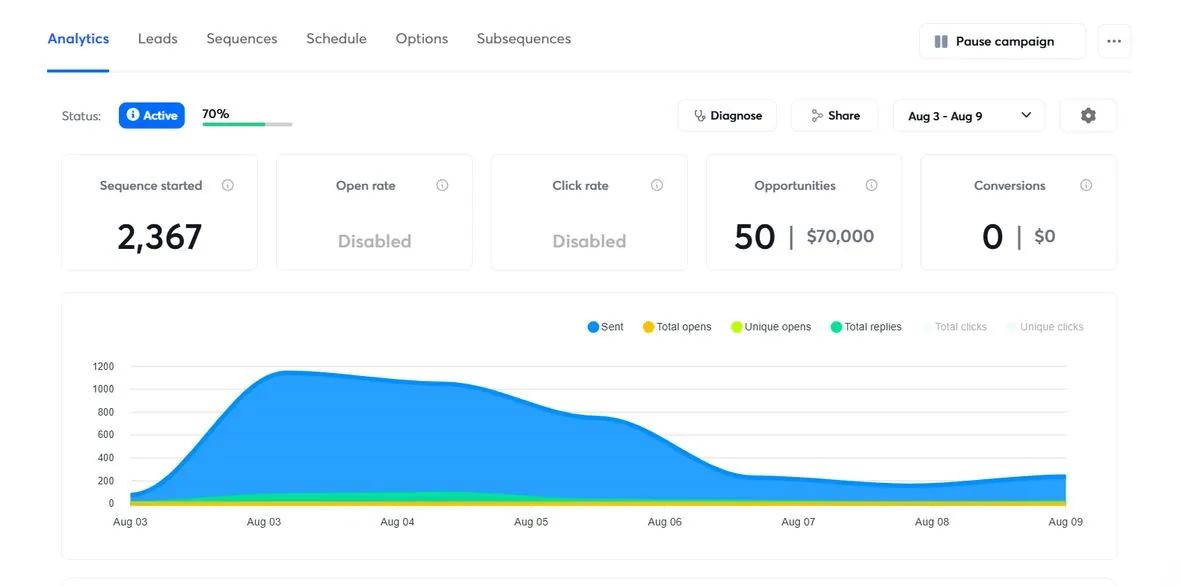
50 opportunities in one week
50 opportunities in one week2,367 prospects into sequence, 50 opportunities, $70,000 of pipeline. Single campaign, single week.
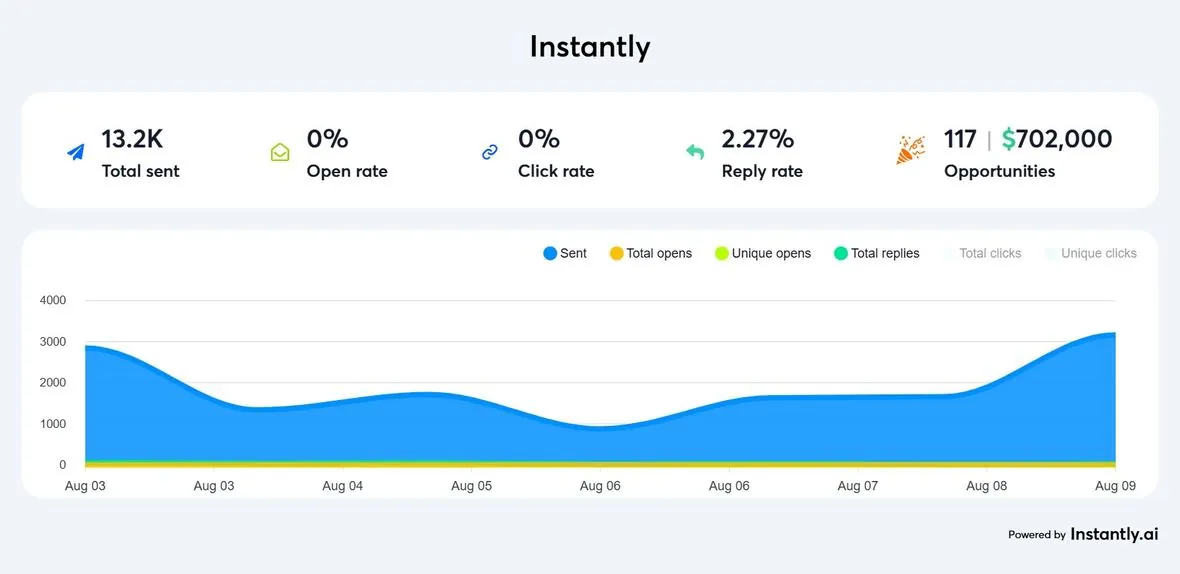
$702,000 of pipeline
$702,000 of pipeline13,200 emails sent, 2.27% reply rate, 117 opportunities created.
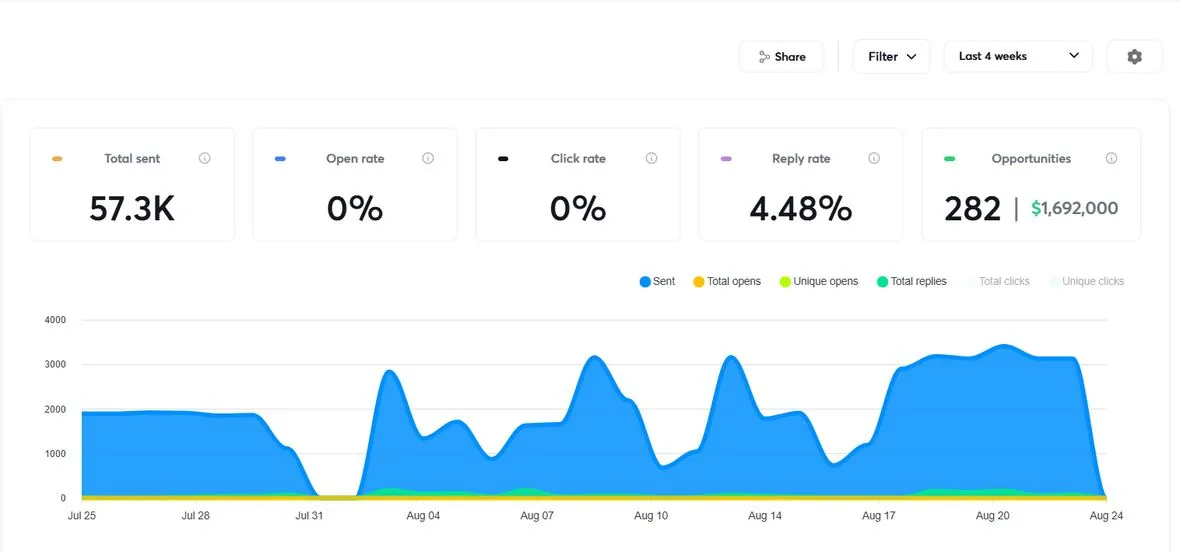
$1.69M of pipeline in four weeks
$1.69M of pipeline in four weeks57,300 emails sent, 4.48% reply rate, 282 opportunities.
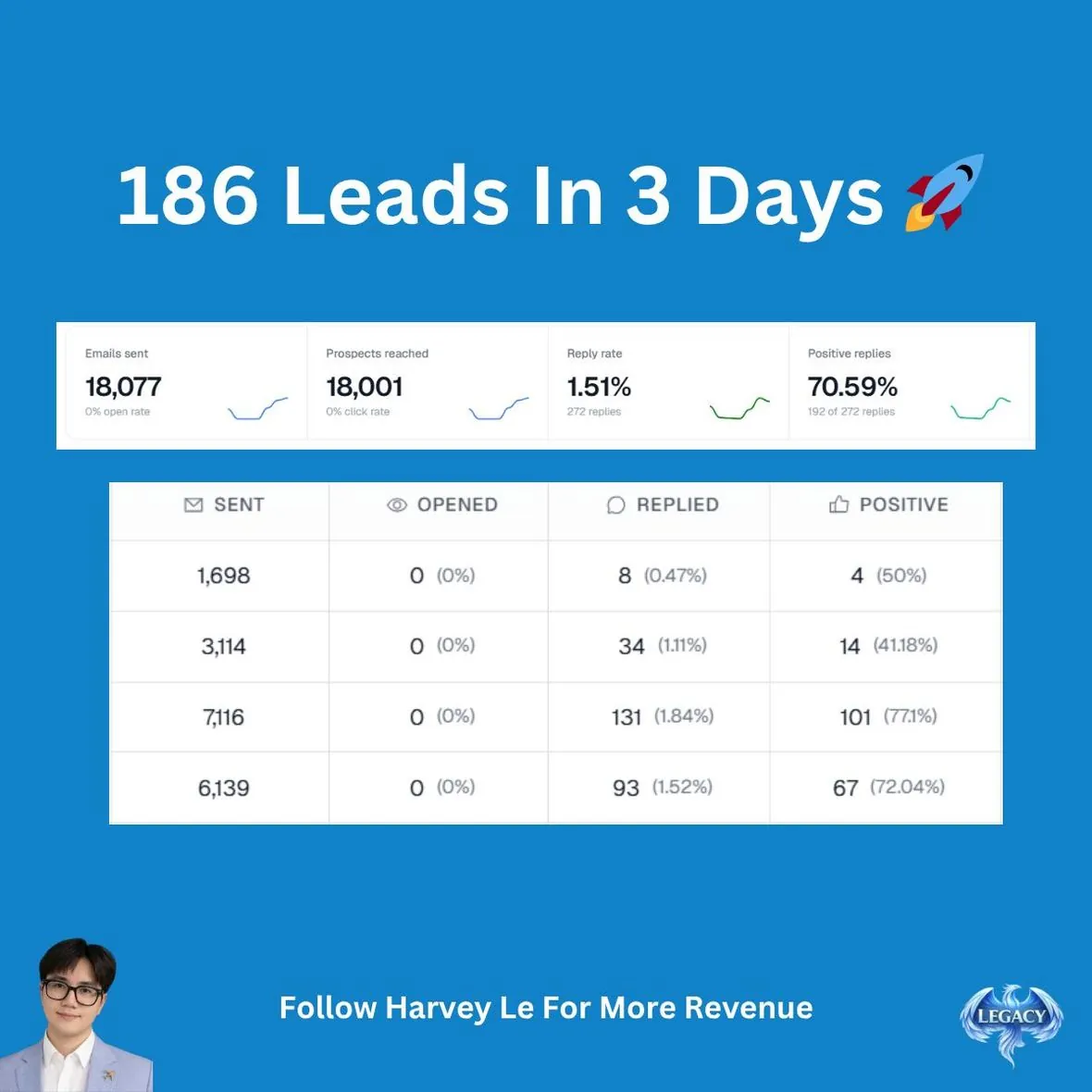
186 leads in 3 days
186 leads in 3 days18,077 emails across four campaigns. 272 replies, 70.59% of them positive.
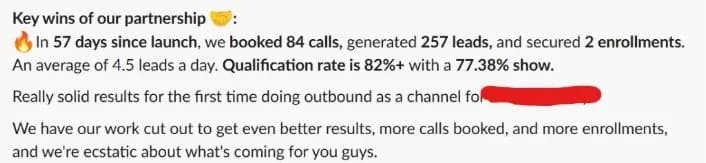
84 calls booked in 57 days
84 calls booked in 57 days257 leads, 4.5 a day, 82%+ qualification rate and a 77.38% show rate. First time this client had run outbound.
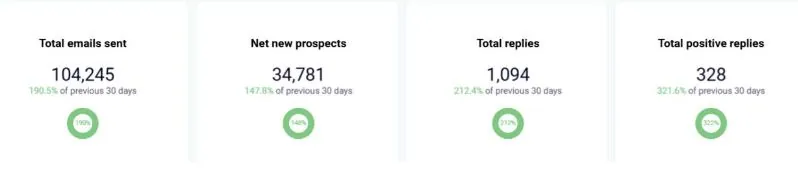
328 positive replies in 30 days
328 positive replies in 30 days104,245 emails sent, 34,781 new prospects reached. Up 321% on the previous 30 days.
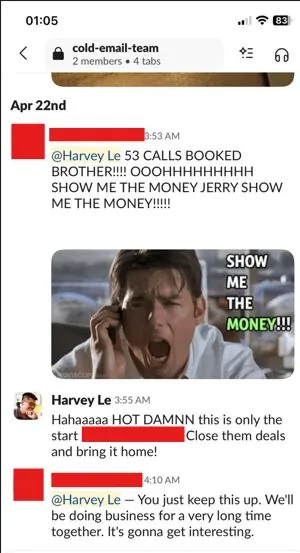
"53 calls booked brother"
"53 calls booked brother"What it looks like in the client Slack channel when a campaign lands.
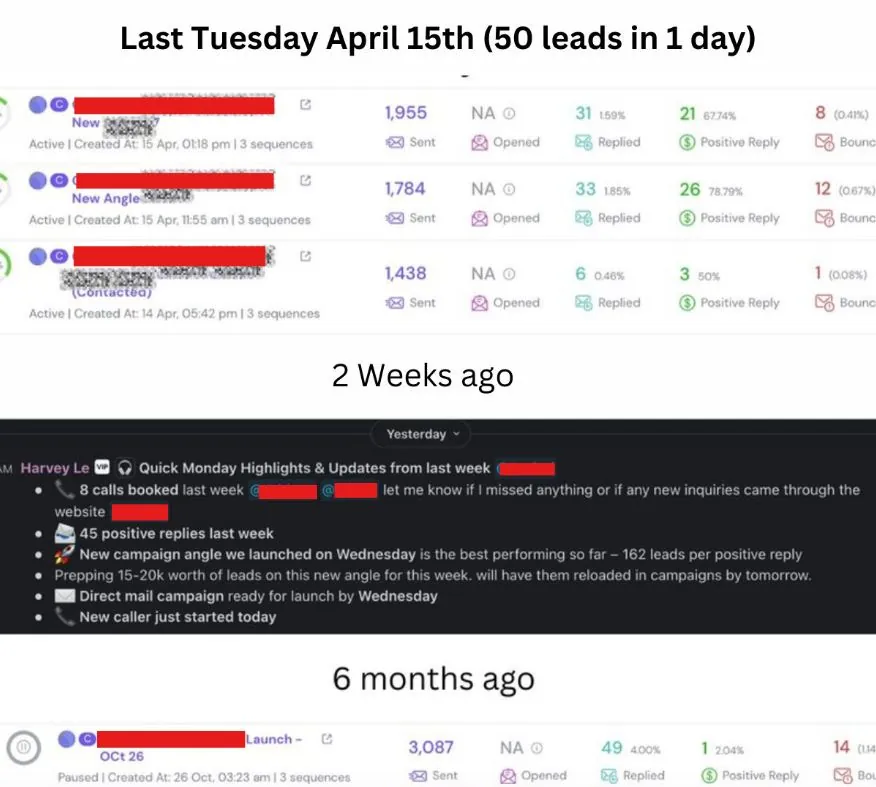
50 leads in a single day
50 leads in a single dayThree campaigns running together, 67% and 79% positive reply rates on two of them.
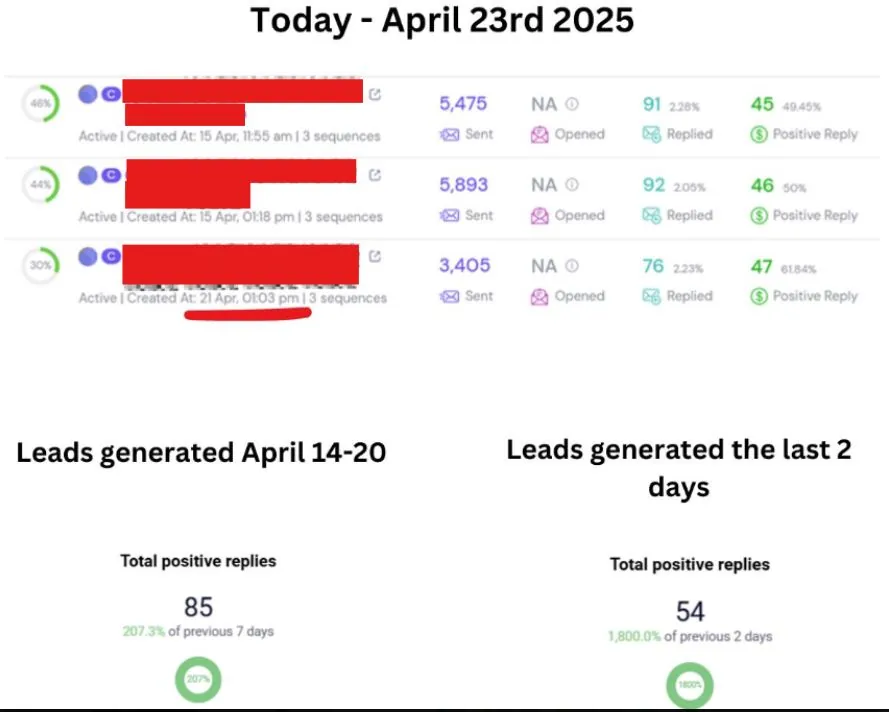
Three live campaigns, 45 to 47 positive replies each
Three live campaigns, 45 to 47 positive replies eachAnd 85 positive replies in one week, up 207% on the week before.
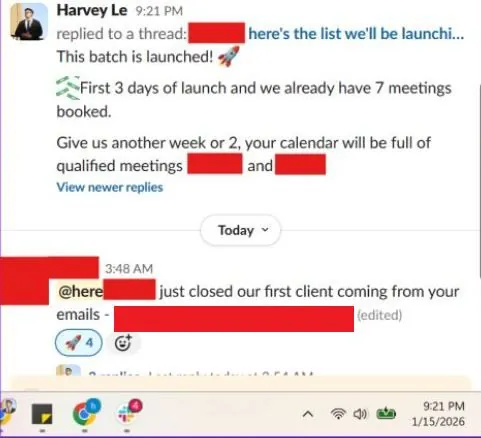
7 meetings booked in the first 3 days
7 meetings booked in the first 3 daysThen the first closed client off the back of the emails.
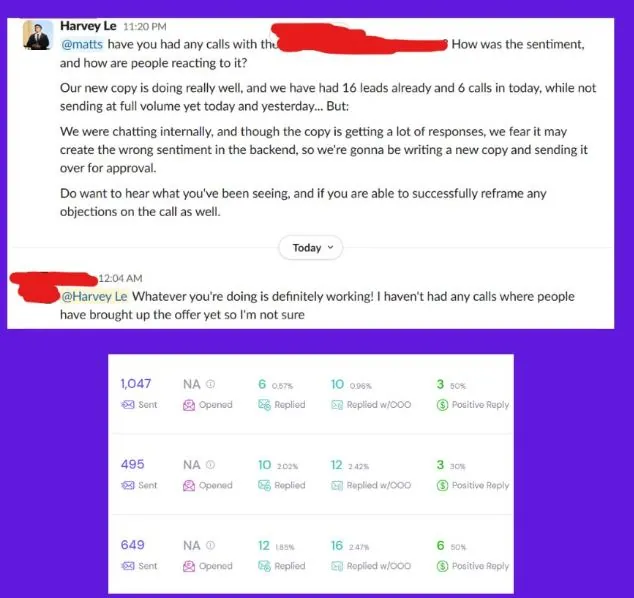
16 leads and 6 calls in one day
16 leads and 6 calls in one dayBefore we were even sending at full volume.
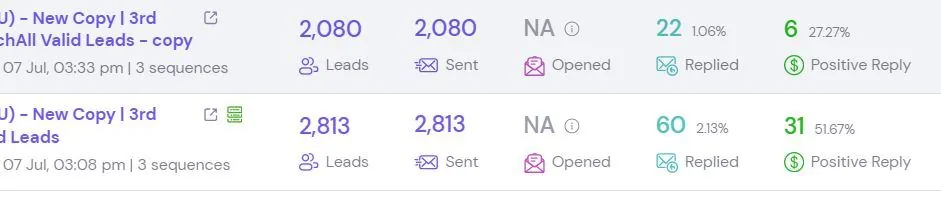
27% and 52% positive reply rate
27% and 52% positive reply rateTwo campaigns, same client, same week.
314 replies, 25 positive
314 replies, 25 positive12,418 leads contacted across the campaign.